
Structured Leasing, Negotiation & Risk Awareness
Leasing space — whether residential or commercial — involves more than simply locating a property. Lease structure, financial obligations, term flexibility, permitted use, renewal rights, and risk exposure can all materially affect the long-term outcome of a tenancy.
Whether leasing a home, office, retail space, industrial unit, or investment-related property, tenant representation should help ensure the lease is structured properly from the outset.
We provide professional tenant representation services throughout Oshawa, Whitby, Ajax, Pickering, Clarington, Durham Region, Toronto, and surrounding Ontario markets.
We help tenants understand risks, evaluate opportunities, negotiate terms, and make informed leasing decisions.
Many tenants focus primarily on location, monthly rent, and availability.
However, the long-term impact of a lease is often determined by:
- how the lease is structured
- what obligations and restrictions exist
- how costs are allocated
- what flexibility or renewal rights are available
- what risks exist within the agreement
A poorly structured lease can lead to:
- unexpected operating costs
- restrictive use provisions
- renewal or termination complications
- financial exposure and disputes
- reduced flexibility over time
Whether leasing a residential home, retail storefront, office space, or industrial facility, our objective is to help tenants understand their options, evaluate lease obligations, identify potential risks, and make informed decisions aligned with their occupancy requirements and long-term objectives.
A Structured Approach to Leasing
Effective tenant representation involves more than arranging property showings.
Our role is to guide clients through the leasing process strategically — from property evaluation and negotiation through documentation and occupancy.
Services may include:
✔ defining space requirements and leasing objectives
✔ identifying and evaluating suitable properties
✔ reviewing market conditions and comparable lease structures
✔ analyzing lease terms and financial implications
✔ structuring offers and negotiating terms
✔ coordinating due diligence and documentation
✔ managing the process through occupancy and possession
“You’re not simply securing space — you’re entering into a legally binding agreement that should be structured properly from the beginning.”
Here’s a clear view of how tenant representation works—and what it means for you.
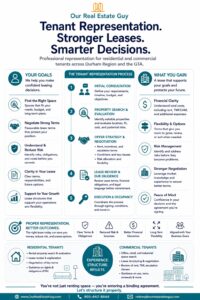
Residential & Commercial Tenant Representation
🏠 Residential Tenants
Representation may include:
- rental property search and evaluation
- review of lease terms and obligations
- negotiation of occupancy dates and key conditions
- guidance regarding rights and obligations under Ontario tenancy legislation
- coordination of documentation and application requirements
This approach is designed to help tenants better understand the lease they are entering into before committing.
🏢 Commercial Tenants
Commercial leasing often involves more complex financial and operational considerations than residential leasing.
Representation may include:
- retail, office, and industrial space search
- lease structuring and negotiation
- review of rent, TMI, escalation clauses, and occupancy costs
- guidance regarding permitted use, exclusivity, renewal options, and term flexibility
- coordination of documentation, timelines, and due diligence
“Commercial leases are not standardized and often require careful review before signing.”
What Makes Our Leasing Services Different?
We help tenants understand risks, evaluate opportunities, negotiate terms, and make informed leasing decisions.
Our leasing services are designed to provide more than simply locating available properties. Whether leasing a residential home, apartment, retail storefront, office space, or industrial facility, our objective is to help tenants understand their options, evaluate lease obligations, identify potential risks, and make informed decisions aligned with their occupancy requirements and long-term objectives.
Depending on the property and service package selected, tenants may benefit from property search assistance, market analysis, lease review, negotiation support, transaction management, move-in documentation, and guidance throughout the leasing process.
“Our focus is not simply on finding a property. Our focus is on helping tenants understand the commitments they are making, evaluate available alternatives, and navigate the leasing process with greater confidence and clarity.”
Residential & Commercial Tenant Advisory
Not all leasing transactions carry the same level of complexity.
Residential tenants may require guidance understanding tenancy rights, landlord requirements, and lease obligations. Commercial tenants may need assistance evaluating lease structures, occupancy costs, renewal provisions, maintenance obligations, operating expenses, or other business-related considerations.
Professional guidance can help tenants better understand available options, evaluate risks, and make informed leasing decisions aligned with their personal or business objectives.
Tenant Preparation & Leasing Strategy
Successful leasing often begins before the first property is viewed.
Depending on the tenant’s circumstances, assistance may be provided with identifying occupancy requirements, establishing a property search strategy, understanding typical landlord expectations, and preparing the documentation commonly requested during the tenant evaluation process.
This may include guidance regarding rental applications, identification requirements, credit reporting, references, income verification, and other information that landlords frequently request when evaluating prospective tenants.
By preparing in advance, tenants can often improve their ability to secure suitable properties and respond more effectively in competitive rental markets.
Property Search & Market Evaluation
Finding a suitable property involves more than simply reviewing available listings.
Our approach focuses on understanding the tenant’s objectives, occupancy requirements, budget considerations, preferred locations, and desired property features before conducting a search.
Services may include MLS® searches, automated listing alerts, property evaluations, viewing coordination, market information, rental rate analysis, and ongoing communication regarding available opportunities.
The objective is to help tenants identify properties that align with their needs while avoiding unnecessary time spent pursuing unsuitable opportunities.
Neighbourhood & Property Evaluation
The property itself is only one part of a leasing decision.
Depending on the property and location, tenants may receive information regarding neighbourhood amenities, schools, transportation options, healthcare services, utilities, and other factors that may influence day-to-day occupancy.
Understanding the surrounding area can be just as important as understanding the property itself, particularly when relocating to a new community or establishing a business in an unfamiliar market.
Lease Review & Negotiation Support
A lease agreement establishes important rights, obligations, and financial commitments that may continue for months or years.
Depending on the transaction, services may include reviewing lease terms, discussing landlord requirements, identifying potential concerns, explaining common lease provisions, preparing offers to lease, and assisting with negotiations.
Whether leasing a residential home, retail storefront, office space, or industrial facility, our objective is to help tenants better understand the commitments they are making before entering into a legally binding agreement.
Thoughtful review and negotiation at the beginning of a tenancy can often reduce misunderstandings and create clearer expectations for both parties.
Transaction Coordination
Once a lease has been negotiated, there are often numerous administrative details that must be completed before occupancy.
Services may include deposit coordination, utility account information, fulfillment of lease conditions, electronic document execution and occupancy transition support.
Our objective is to help tenants navigate the leasing process efficiently while ensuring important details are properly documented and communicated.
Move-In Documentation & Property Condition Reporting
Many landlord and tenant disputes arise not because of bad intentions, but because important details were not properly documented at the beginning of the tenancy.
Depending on the service package selected, representation may include a property walk-through, move-in inspection reporting, property condition photography, utility information preparation, and occupancy transition support.
Clear documentation helps establish the property’s condition at the commencement of the tenancy and creates a useful reference point for both landlords and tenants throughout the lease term.
Proper documentation supports transparency, reduces misunderstandings, and can assist in addressing questions that may arise in the future.
“Few leasing brokerages provide this level of documentation and risk management support.”
Transparent Tenant Representation
Professional tenant representation helps protect your interests throughout the leasing process.
Residential Tenant Representation
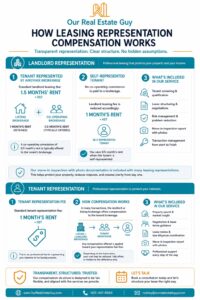
Our standard residential tenant representation fee is:
From 1 month’s Rent + HST
Included
- Needs and timing consultation
- Property search and evaluation
- Showing coordination
- Coordination of documentation and application requirements
- Offer-to-lease preparation
- Review of lease terms, obligations and documentation
- Negotiations
- Transaction coordination
- Move-in inspection and condition documentation
In many residential lease transactions, the landlord or listing brokerage may offer compensation to the tenant’s brokerage. Where applicable, that compensation is applied toward the agreed representation fee first, which may reduce or fully offset the tenant’s direct cost.
Commercial Tenant Representation
Commercial tenant representation fees vary depending on the type of property, lease structure, transaction complexity, lease term, negotiation scope, and advisory services required.
Compensation structures in commercial leasing commonly include:
- landlord/listing brokerage co-operating commission structures;
- percentage-based lease commissions;
- per-square-foot fee structures;
- fixed advisory or negotiation fees;
- or customized fee arrangements depending on the assignment.
Commercial tenant representation may include:
- site selection and occupancy strategy;
- Letters of Intent and offer negotiations;
- lease review and risk analysis;
- rent and additional rent review;
- operating cost and TMI analysis;
- renewal, relocation, exclusivity, assignment, and termination clause review;
- landlord negotiations;
- and coordination with lawyers, contractors, lenders, and other advisors.
Where compensation is offered by the landlord or listing brokerage, that compensation is typically applied toward the agreed representation fee first.
Included Services
Services may include:
- property search assistance,
- negotiation support,
- lease review guidance,
- due diligence coordination,
- and a detailed move-in inspection report with photographs.
FEE
Structured according to the assignment and agreed before representation begins.
Professional fees, service scope and client responsibilities are agreed before representation begins and are subject to the applicable representation agreement.
Professional Services and Client Commitment
My representation services are structured as a professional engagement rather than an arrangement in which all services become free if a client later decides not to proceed.
In most successful transactions, the agreed professional fee is paid through the transaction in the manner established in the representation agreement. However, substantial professional services and direct costs may be incurred well before a transaction closes. Depending upon the circumstances, the representation agreement may therefore provide for reimbursement of reasonable expenses if the engagement ends before completion and the Brokerage is not otherwise entitled to its commission.
The representation agreement also identifies circumstances in which a professional fee may already have been earned even though the transaction does not ultimately complete, including certain circumstances involving client default, voluntary withdrawal, default by another party or a transaction completed during an applicable holdover period.
These provisions are reviewed before representation begins so that both the client and the Brokerage understand the financial commitment before professional services are undertaken.
Understand the obligation before it becomes the commitment.
How I Guide You Through the Process
1. Initial Consultation & Leasing Strategy
Review your space requirements, operational needs, timing, budget, and leasing objectives.
2. Property Search & Evaluation
Identify suitable properties and assess market positioning, value, operational fit, and risk considerations.
3. Offer Strategy & Negotiation
Structure pricing, lease terms, timelines, and conditions aligned with your goals and occupancy requirements.
4. Lease Review & Due Diligence
Review obligations, occupancy costs, lease clauses, restrictions, and transaction conditions before commitment.
5. Documentation, Execution & Occupancy
Coordinate documentation, signing, deposits, timelines, and possession through occupancy.
What Tenants Often Don’t See
Many important steps in a leasing transaction occur behind the scenes long before a lease is signed.
Depending on the property and transaction, tenant representation may involve:
- reviewing comparable properties and market conditions
- analyzing lease structures and long-term cost implications
- identifying risks in lease clauses and occupancy terms
- coordinating communication with landlords, agents, lawyers, and third-party professionals
- managing negotiations, documentation, timelines, and due diligence requirements
The quality of these behind-the-scenes steps can materially affect flexibility, cost exposure, and long-term lease outcomes.
What This Approach Is Designed to Provide
✔ greater clarity around lease obligations and costs
✔ structured negotiation and transaction guidance
✔ improved understanding of risk and lease exposure
✔ alignment between lease structure and operational objectives
✔ stronger decision-making before commitment
The objective is not simply to secure space — it is to structure the tenancy properly before signing.
Who I Work With
Residential Tenants
- individuals and families
- relocation and lifestyle moves
- condominium and rental housing tenants
Commercial Tenants
- business owners and operators
- startups and expanding companies
- office, retail, and industrial tenants
- investors securing operational or income-producing space
Who This Leasing Approach Works Best For
This approach is particularly effective for:
- tenants seeking greater clarity around lease obligations and costs
- business owners negotiating office, retail, or industrial space
- residential tenants navigating relocation or lifestyle changes
- clients requiring structured negotiation and lease review support
- tenants who want a better understanding of risk, flexibility, and long-term lease implications
Tenant Representation Services in Durham Region and the GTA
We provide tenant representation services throughout Oshawa, Whitby, Ajax, Pickering, Clarington, Durham Region, Toronto, and surrounding Ontario markets.
Whether leasing residential, office, retail, industrial, or mixed-use space, our approach is built around structure, transparency, negotiation strategy, and informed decision-making.
Let’s Structure Your Lease Properly
Leasing decisions should not be rushed or assumed. The structure of the lease can materially affect costs, flexibility, operational stability, and long-term obligations.
A structured leasing approach helps tenants better understand:
✔ lease obligations and restrictions
✔ occupancy costs and financial exposure
✔ negotiation strategy and flexibility
✔ documentation and due diligence considerations
✔ operational and long-term leasing risks
“Real estate leasing involves more than simply finding space — it involves protecting your position before committing to a binding agreement.”
👉 Book a consultation
👉 Review your leasing strategy
👉 Move forward with clarity
Related Tenant Resources
Inside a Real Estate Transaction: What Tenant Representation May Involve
 Tenant representation services
Landlord representation services
Tenant screening and lease risk guide
Tenant FAQ
Landlord FAQ