

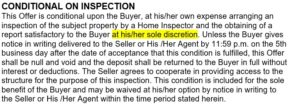
Conditional clauses are an important part of real estate transactions because they give a buyer or seller time to deal with uncertainty before becoming fully committed to a particular outcome. A buyer may need to arrange financing, inspect the property, review condominium documents or investigate whether a property can support an intended use. In a commercial transaction, the investigation may extend further into zoning, environmental matters, leases, operating expenses, building systems or development potential.
Some conditions state that the decision about whether the condition has been satisfied belongs to one party in their “sole discretion” or “sole and absolute discretion.” To a reader unfamiliar with contract law, that language can sound almost unlimited. A buyer may reasonably think that if satisfaction is entirely within their discretion, they can simply decide later that they no longer want the property and allow the condition to expire.
That is not necessarily how the clause works.
A sole-discretion clause gives someone judgment, but it does not automatically give them an unrestricted right to use the condition for any unrelated reason. The wording of the agreement, the purpose of the condition and the circumstances surrounding the decision all matter. Ontario courts have recognized that contractual discretion must be exercised honestly and in good faith, while the Supreme Court of Canada has explained that contractual discretion should be exercised consistently with the purpose for which it was granted.
For buyers and sellers, the practical lesson is easier to understand if we begin with the reason the condition exists.
Start With the Risk the Condition Was Intended to Address
Every meaningful condition should be connected to a particular uncertainty in the transaction. A financing condition gives the buyer an opportunity to determine whether appropriate financing can actually be obtained. An inspection condition allows the buyer to investigate the physical condition of the property. A condominium review may allow the purchaser to understand the corporation’s finances, rules and obligations before becoming committed.
Commercial due diligence can be broader because the suitability of the property may depend upon several interconnected issues. A purchaser may need to confirm zoning, environmental condition, tenant obligations, operating expenses, financing, building systems or whether the property can accommodate a particular business activity.
The purpose of the clause matters because it helps explain what the discretion is there to accomplish. If the buyer discovers information that genuinely relates to the risk being investigated, the condition may give the buyer meaningful room to decide whether that risk remains acceptable. If nothing relevant has changed and the buyer simply prefers another property that came onto the market, the situation is very different.
In other words, the words “sole discretion” do not erase the reason the condition was negotiated in the first place.
Good Faith Does Not Mean the Buyer Must Accept Every Problem
The requirement to act honestly and in good faith should not be misunderstood as requiring the buyer to overlook genuine concerns.
A buyer may discover a problem during an inspection that another purchaser would happily accept. That does not automatically make the first buyer unreasonable. Different buyers have different financial resources, renovation plans, risk tolerances and reasons for purchasing.
Ontario’s Court of Appeal considered this issue in Marshall v. Bernard Place Corp., where an inspection condition required a report satisfactory to the purchaser in the purchaser’s sole and absolute discretion. The court recognized that discretionary conditions can involve both objective and subjective elements, and that the purchaser was entitled to rely upon genuine deficiencies identified through the inspection process.
That is an important distinction. The law does not necessarily require a buyer to accept a problem simply because the seller believes it is minor. The question is whether the buyer is genuinely exercising the discretion in connection with the purpose of the clause.
A buyer concerned about an aging roof, moisture, electrical deficiencies and substantial deferred maintenance may reasonably look at those findings collectively and decide that the property no longer fits the financial or practical assumptions behind the purchase. The fact that another buyer might proceed does not necessarily invalidate that judgment.
Professional Insight: A useful way to assess a discretionary condition is to ask: What did we learn during the conditional period that affects the risk this clause was intended to investigate? If the answer has nothing to do with that risk, legal advice may be appropriate before assuming the condition creates an unrestricted right to terminate.
Financing Conditions Illustrate the Difference Clearly
Financing conditions provide a good example because buyers sometimes assume that a mortgage pre-approval or pre-qualification means financing is already settled. In practice, a lender may still need to approve the borrower, the property, the appraisal and other underwriting requirements before committing to the transaction.
If a buyer makes reasonable efforts to obtain financing but discovers that the available mortgage is materially different from what was anticipated, the condition may be doing exactly what it was intended to do. The buyer is using the conditional period to determine whether the purchase can be financed on acceptable terms.
The situation becomes more complicated if suitable financing is readily available but the buyer no longer wants the property for an unrelated reason and tries to use the financing condition as a convenient exit.
The important difference is not whether the buyer ultimately proceeds. It is whether the decision actually relates to the financing risk the clause was intended to address.
This is why buyers should not treat a financing condition as a general cooling-off period unless the agreement clearly provides that type of right.
Inspection Conditions Are About the Buyer’s Actual Decision
Inspection clauses can be misunderstood in a similar way because buyers sometimes think they need to find a catastrophic defect before deciding not to proceed.
That is not necessarily the case.
A home inspection may reveal several issues that individually appear manageable but collectively change the economics or practicality of the purchase. A roof approaching the end of its useful life, older wiring, moisture concerns and aging mechanical systems may represent a level of near-term expenditure that the buyer did not anticipate when making the offer.
The significance of those findings depends partly upon the buyer’s circumstances. A purchaser planning a major renovation may view the deficiencies differently from a buyer who expected to move into the property with minimal immediate expense.
What matters is the connection between the inspection and the decision. If the buyer is genuinely evaluating the findings and concludes that the property no longer presents an acceptable level of risk, the condition is functioning as a due-diligence tool rather than as a convenient excuse to reconsider the purchase.
Commercial Due Diligence Makes the Same Principle Even More Important
The issue becomes even clearer in commercial and industrial transactions because the purchaser may be investigating several different risks at the same time.
A building can be physically sound and still be unsuitable for the purchaser’s objectives. An industrial user may discover that the electrical service is inadequate for its equipment. A retail investor may learn that an existing lease restricts a future use. Environmental investigation may reveal potential remediation exposure, while zoning may allow the current use but prevent the expansion the purchaser intended.
None of those issues necessarily means that the property is defective in an absolute sense. They may simply mean that the property does not work for that particular buyer.
A well-drafted due-diligence condition can give the purchaser room to evaluate those interconnected considerations, but the scope of that discretion still depends upon what the agreement actually says and what the clause was intended to investigate.
This is where the residential and commercial applications of the principle meet. In both cases, the condition allows the party to assess a genuine transaction risk. The difference is that commercial due diligence often involves a much wider collection of technical, financial and operational information before the buyer can decide whether the acquisition remains acceptable.
Changing Your Mind Is Different From Discovering an Unacceptable Risk
Real estate transactions can become emotional, particularly once an offer has been accepted.
A buyer may begin second-guessing the decision. Another property may come onto the market. Family members may express concern. The buyer may start worrying about moving, carrying costs or whether the purchase was made too quickly.
Those feelings can be entirely genuine, but they are not necessarily the same as the risk protected by the contractual condition.
If the real problem is simply that the buyer no longer wants the property, an unrelated financing, inspection or due-diligence condition should not automatically be assumed to provide a convenient way out. An accepted Agreement of Purchase and Sale is a contract, and failing to complete it can have serious financial consequences depending upon the circumstances.
The better approach is to separate the emotional reconsideration from the contractual issue. If the buyer has genuinely changed their mind for reasons unrelated to the condition, the appropriate step is to obtain advice about the contractual position rather than trying to make an unrelated condition fit the decision after the fact.
Documentation Helps Explain How the Decision Was Reached
Good documentation is valuable during any conditional period because it helps the buyer, REALTOR® and other advisors keep track of what has been investigated, what has been discovered and what remains unresolved.
If financing becomes problematic, records of lender discussions and proposed terms can help everyone understand the difficulty. If an inspection identifies concerns, the report, estimates and related communications create a clearer picture of what influenced the buyer’s decision. In a commercial transaction, environmental reports, zoning correspondence, lease reviews, engineering assessments and financial analysis can collectively show how the purchaser reached a conclusion about the property.
The purpose of documentation is not to create a paper trail after the buyer has already decided to terminate. It should develop naturally from the due-diligence process itself.
That distinction matters. Records produced while the investigation is actually happening are usually much more useful than attempting months later to reconstruct what everyone was thinking when the condition was outstanding.
Communication Can Sometimes Turn a Problem Into a Negotiation
Discovering an unacceptable issue does not always mean the transaction must end.
An inspection may reveal a repair that neither party anticipated. A financing problem may be resolved by changing timing or structure. Commercial due diligence may uncover a building issue that can be addressed through a price adjustment, holdback, repair obligation or another negotiated solution.
Whether negotiation is appropriate depends upon the seriousness of the problem and the objectives of the parties. Some issues genuinely make the property unsuitable, while others simply change the economics.
Clear communication allows the parties to determine which situation they are dealing with.
It also helps distinguish genuine due diligence from a last-minute attempt to manufacture a reason for terminating the agreement. Where the buyer raises concerns promptly, explains what has been discovered and considers realistic solutions where appropriate, the process is much easier to understand.
The Deadline Is Part of the Protection
A conditional clause almost always operates within a defined period, and that timeframe is part of the bargain between the parties.
The buyer receives an opportunity to investigate a particular uncertainty, but the seller is not expected to remain indefinitely unsure about whether the transaction will proceed. The deadline therefore creates a point at which the condition must be satisfied, waived, extended or dealt with according to the language of the agreement.
This is another reason due diligence should begin early.
Waiting until the final hours to arrange financing, book an inspection or review important documentation can create avoidable pressure. Commercial investigations can be particularly vulnerable because several consultants, lawyers, lenders and internal decision-makers may need to complete their work within the same conditional period.
If the investigation cannot reasonably be completed, the parties may be able to negotiate an extension, but neither side should assume that one will automatically be granted.
A condition provides time, but it also creates a responsibility to use that time effectively.
The Wording of the Clause Matters More Than the Label
One of the dangers with expressions such as “sole discretion,” “condition precedent” or “due diligence condition” is that people begin to treat the label as though it determines the legal result.
It does not.
Two clauses can both contain the words “sole discretion” and still operate differently because the surrounding language, purpose and structure are different. Ontario courts have specifically recognized that whether a discretionary condition involves a more subjective or objective assessment depends upon the intention of the parties as reflected in the contract.
The Supreme Court of Canada’s broader contractual-discretion jurisprudence reinforces the same underlying principle: discretion is interpreted in relation to the purpose for which the contract granted it.
For clients, the practical message is much simpler than the legal analysis. Do not assume that two conditions work the same way merely because they use the same familiar phrase.
Read the clause as a whole and understand what it was designed to accomplish.
Buyers Should Know What the Condition Protects Before Signing the Offer
The best time to understand a discretionary condition is before the Agreement of Purchase and Sale becomes binding.
The buyer should know what is being investigated, what information is likely to be required, how long the investigation will take and what decision the condition is intended to support.
A financing condition should be drafted around the buyer’s actual financing uncertainty. An inspection condition should provide enough time to obtain the investigation the property reasonably requires. A commercial due-diligence condition should reflect the information and specialist advice needed to determine whether the acquisition works for the buyer’s intended use or investment strategy.
This improves more than legal clarity. It improves decision-making.
When everyone understands at the beginning what question the condition is supposed to answer, it becomes much easier later to determine whether the information discovered during due diligence genuinely affects that question.
Professional Insight: A well-structured condition should make the decision easier, not simply make termination easier. Before signing, the buyer should understand what uncertainty the clause is designed to resolve and what information will be needed to make that decision intelligently.
Sellers Also Need to Understand the Scope of the Discretion They Are Accepting
The issue is not only important to buyers.
When a seller accepts an offer containing a broadly worded discretionary condition, the seller is agreeing to a period in which the purchaser retains meaningful decision-making authority. The seller should therefore understand how broad that authority is and how long the uncertainty may continue.
A seller may reasonably accept that flexibility because the price and other terms are attractive. In another situation, the seller may want the condition narrowed, shortened or tied more specifically to the investigation being contemplated.
Commercial transactions can make this particularly important because a broadly drafted due-diligence condition may allow the purchaser to investigate many aspects of the property and business assumptions before becoming firm.
The objective is not to remove legitimate protection from the buyer. It is to ensure that both parties understand how much uncertainty the agreement is actually creating and how that uncertainty is being allocated.
Professional Representation Helps Connect the Clause to the Decision
The real value of a conditional clause appears when information begins to arrive.
An inspector identifies deficiencies. A lender changes financing terms. A condominium review raises concerns. An environmental consultant recommends further investigation. A commercial tenant review reveals an unexpected obligation.
At that point, the client needs more than the wording of the clause. They need help understanding what the information means for the transaction.
The REALTOR® can help organize the investigation, keep track of deadlines, communicate with the other side and identify when legal, lending, engineering or other specialist advice is required. The decision ultimately belongs to the client within the rights created by the agreement, but professional representation helps connect the technical findings back to the reason the client is buying the property.
That is particularly important because due diligence can produce large amounts of information without automatically producing an obvious answer.
The question is not simply whether a problem exists. It is whether that problem changes the transaction enough that the client should proceed, renegotiate, investigate further or exercise whatever contractual rights are available.
Final Thoughts
Sole-discretion clauses can provide meaningful protection in both residential and commercial real estate transactions. They allow a buyer or seller to make an important decision after obtaining information that was not reasonably available when the agreement was signed.
The words “sole discretion,” however, should not be understood as meaning “for absolutely any reason.” The discretion exists within the agreement, and its proper use is connected to the purpose for which the contractual right was created. Ontario courts have consistently treated good faith as an important limitation on the exercise of contractual discretion.
For buyers, the most useful approach is to understand before signing what risk the condition is intended to investigate and what information will be required to decide whether that risk is acceptable. For sellers, the important consideration is understanding how much discretion is being granted and how that may affect certainty during the conditional period.
When the condition is eventually exercised, the decision should flow naturally from the investigation rather than from an unrelated desire to escape the transaction.
That does not weaken the protection provided by the clause. It makes the protection more meaningful because it connects contractual discretion to the real uncertainty the parties intended to address.
A well-drafted condition therefore does more than provide an exit.
It creates a structured opportunity to investigate uncertainty, understand risk and make a better-informed real estate decision.
Guidance for Smarter Real Estate Decisions.
This article provides general information only and does not constitute legal advice. The legal effect of a discretionary condition depends upon the wording of the Agreement of Purchase and Sale and the circumstances in which the discretion is exercised. Buyers and sellers should obtain legal advice where there is uncertainty about their contractual rights or obligations.
Written by Rodney Harvey, Broker of Record at Konfidis, Brokerage providing advisory-focused commercial, industrial, investment, and real estate brokerage services across Oshawa, Durham Region, and Ontario.
Continue Building Your Transaction Knowledge
You may also find these articles helpful:
 Clause Architecture: Best Practices for Structuring Clear, Enforceable, and Operationally Effective Clauses
The Risks of Poorly Drafted Clauses in Ontario Real Estate
Common Litigation Issues in Agreements of Purchase and Sale
What Real Estate Litigation Teaches Buyers in Ontario
Why Conditional Clauses Matter in Ontario Real Estate
Contracts and Clauses You May See in Ontario Real Estate Transactions
How Unclear Wording Creates Financial, Operational, and Relationship Risk
Put my expertise to work for you!
“If you require professional guidance regarding representation structure, transaction strategy, commercial leasing, investment property, due diligence, or real estate advisory services, consultation and representation options may be available depending on your objectives and circumstances.”