

Organizations rarely move from one governance model to another overnight.
A business, brokerage, professional practice or other organization may recognize that its existing approach to governance has become too operational, too dependent on individual decision-makers, or too focused on managing immediate issues. Leadership may want to establish a more strategic approach in which priorities, risk, resources, accountability and long-term direction are considered more deliberately.
The challenge is that recognizing the need for Strategic Governance does not immediately create it.
Between the governance structure an organization has today and the structure it ultimately wants, there is often a period during which responsibilities, authority, reporting relationships and decision-making processes are changing. That period can be understood through a Transitional Governing Approach. As the transformation progresses, organizations may also begin operating through a Hybrid Governing Approach, combining strategic and operational forms of governance while determining which decisions properly belong at each level.
Understanding these different approaches can help leadership avoid a common mistake: assuming that governance transformation is simply a matter of creating new committees, policies or reporting structures. Effective governance transformation is ultimately about changing how decisions are made, where authority resides, how accountability is established and how the organization connects today’s operations with tomorrow’s objectives.
Operational Governance: Governing the Organization We Have
Operational Governance is concerned primarily with ensuring that the organization functions appropriately within its existing structure.
That normally includes oversight of policies, procedures, budgets, regulatory requirements, operational performance, staffing responsibilities, reporting and compliance. The emphasis is on whether established processes are functioning as intended, whether responsibilities are being fulfilled and whether problems are being identified and corrected.
Operational governance therefore performs an essential role. Organizations need financial controls, policies, management accountability, compliance processes and mechanisms for supervising day-to-day performance. Even organizations with sophisticated strategic governance cannot dispense with those responsibilities.
The limitation arises when operational governance becomes the dominant lens through which virtually every issue is considered. Leadership can become highly effective at supervising the organization that already exists while devoting comparatively little governance attention to where the organization should be heading. Meetings may become dominated by current problems, reports may focus primarily on what has already happened, and decision-making can become concentrated on individual activities rather than the broader priorities those activities are intended to support.
An organization can therefore be well managed operationally while remaining under-governed strategically.
Why Organizations Begin Moving Toward Strategic Governance
The need for a different governance approach often becomes apparent as an organization grows or becomes more complex.
More people become involved in decisions. Regulatory obligations increase. Financial commitments become larger. Technology, competition and market conditions change. Different business units or professional functions may begin operating with competing priorities. Decisions that once could be handled informally can gradually carry consequences across the organization.
At that point, governance increasingly needs to address matters that extend beyond operational supervision. Leadership must consider organizational direction, resource allocation, risk tolerance, major opportunities, competing priorities and the longer-term consequences of current decisions. Governance becomes less concerned solely with whether the organization is operating properly and more concerned with whether it is pursuing the right objectives and positioning itself appropriately for the future.
Those are Strategic Governance considerations.
However, the organization cannot normally stop operating while it redesigns how it governs itself. This creates the need for an intermediate governing approach capable of maintaining existing responsibilities while the new model is being developed.
Transitional Governance: Governing the Transformation
A Transitional Governing Approach exists when an organization is simultaneously managing its existing responsibilities and changing the way those responsibilities will eventually be governed.
Its purpose is therefore different from either purely operational or fully strategic governance. Operational Governance manages the current organization. Strategic Governance establishes and oversees direction. Transitional Governance manages the movement between the two.
During this period, leadership may be introducing new decision authorities, redefining responsibilities, redesigning reporting structures, improving financial or operational controls, developing new policies, implementing technology, creating management committees or gradually transferring decisions away from individuals toward more formal governance processes.
The organization is effectively operating in two time horizons at once. It must continue making today’s decisions while also building the capacity required to make tomorrow’s decisions differently.
This is why Transitional Governance should be understood as more than a temporary administrative arrangement. It is a governing discipline in its own right because the transformation itself creates risks that must be managed. Responsibilities may overlap, authority can become unclear, legacy processes may continue alongside new ones, and people may not yet understand how decisions are intended to flow through the emerging structure.
Professional Insight
Transitional Governance should have a defined destination. If temporary committees, extraordinary approvals and overlapping responsibilities continue indefinitely, the organization may no longer be transitioning. It may simply have created another layer of bureaucracy.
What Changes During the Transitional Stage?
The most important changes are not necessarily the visible ones.
An organization may create a new committee or adopt a new policy without materially changing how decisions are actually made. Genuine governance transformation occurs when decision rights, accountability and information flows begin changing.
A decision that historically required the owner, president or senior executive personally to become involved may gradually be delegated within a clearly defined authority structure. Conversely, decisions that were once made independently by operating managers may need to be elevated because they carry broader financial, regulatory, reputational or strategic consequences.
Reporting also changes as governance matures. Operational reporting is principally concerned with what has happened and whether current activities are being managed appropriately. Strategic reporting goes further by helping leadership determine what the information means, whether underlying assumptions remain valid and whether action is required in response to emerging conditions.
The transition therefore involves considerably more than adding governance mechanisms. It involves determining which decisions should occur where, what information should support those decisions and who should ultimately be accountable for the outcome.
That is also where Hybrid Governance begins to emerge.
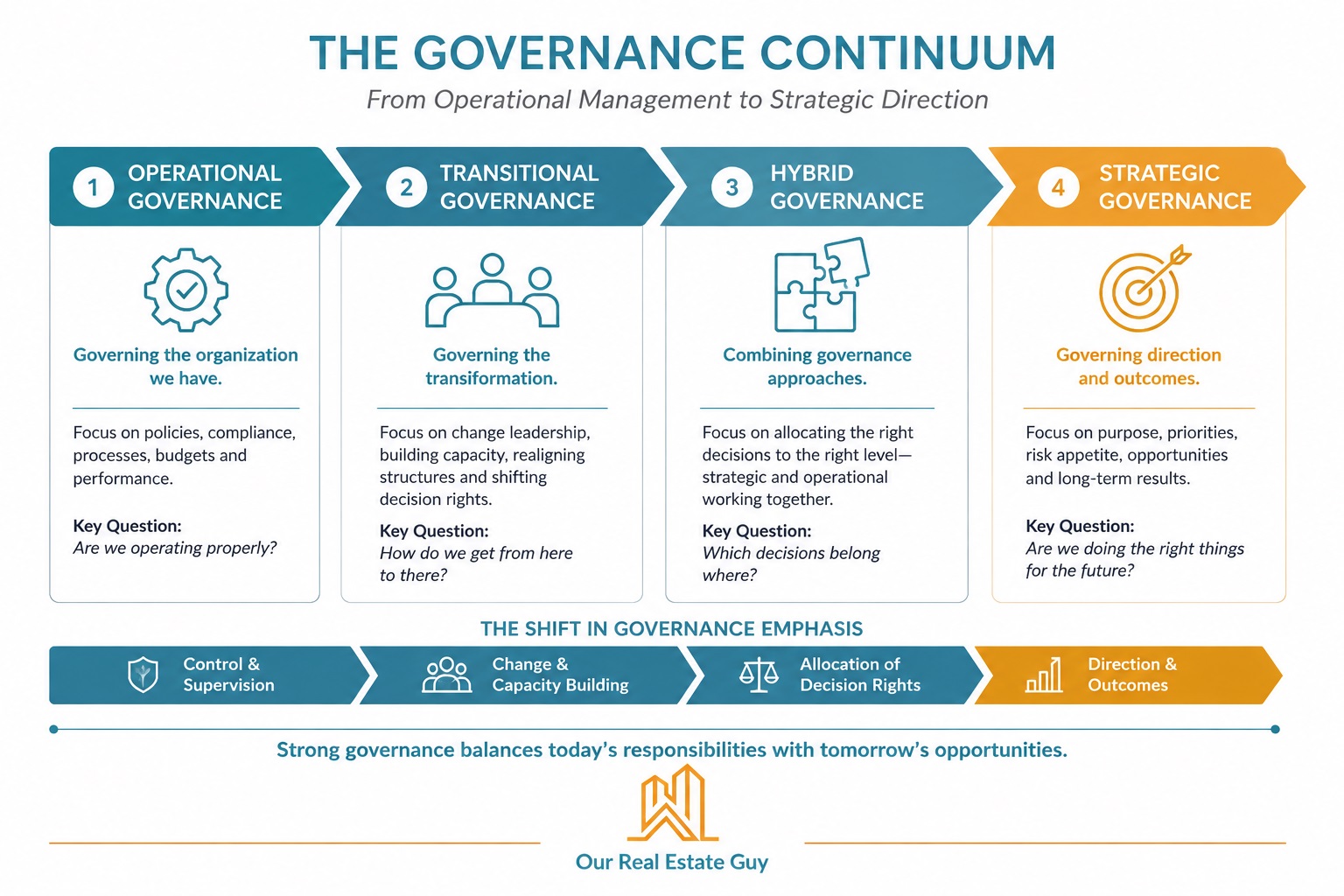
The Governance Continuum
The Governance Continuum illustrates how governance emphasis can evolve from operational supervision through transitional and hybrid approaches toward strategic direction and outcomes.
Hybrid Governance: When Different Approaches Coexist
Hybrid Governance develops when different forms of governance operate together rather than one approach completely replacing another.
This can happen naturally during transformation. Some decisions may already have moved into a more strategic governance structure while others remain appropriately under operational management. Leadership may therefore find itself working through a combination of strategic oversight, management authority, formal controls and delegated decision-making.
Importantly, Hybrid Governance does not necessarily represent an incomplete form of Strategic Governance. It can also be a deliberate and appropriate long-term model.
Not every organizational decision belongs at a strategic governance level. Compliance controls, routine financial administration, standard operating procedures and ordinary management decisions generally require clear operational authority. At the same time, matters involving significant investment, enterprise risk, organizational direction, major contracts, market positioning or long-term commitments may appropriately receive greater strategic oversight.
The governing issue therefore becomes one of allocation: which decisions belong at which level, and what degree of oversight is appropriate to the consequences of the decision?
That distinction is central to effective Hybrid Governance. The model works when strategic and operational authority are intentionally connected, clearly defined and supported by appropriate escalation mechanisms. It becomes problematic when the two coexist without clarity.
Intentional Hybrid Governance Versus Governance by Accident
This distinction is particularly important.
An intentional Hybrid Governing Approach establishes clear boundaries between different levels of authority. People understand which decisions management can make independently, which require consultation, which must be escalated and which properly belong with the governing body. Information flows support those decisions, accountability follows authority and escalation occurs because the nature of the decision requires it rather than because nobody knows who is responsible.
An accidental hybrid looks very different.
Multiple people may believe they have authority over the same issue. Committees may reconsider decisions already made elsewhere. Senior leaders can become unnecessarily involved in routine matters while strategically important decisions fail to receive sufficient attention. Management may wait for approval because decision limits are unclear, while governing bodies become frustrated because they are repeatedly drawn into operational detail.
The organization may therefore appear to have more governance while actually having less clarity.
This is why the quality of governance cannot be measured simply by the number of committees, policies, approvals or reports an organization has. The more useful measure is whether those mechanisms produce clearer accountability, better information and better decisions.
Professional Insight
Adding oversight does not automatically improve governance. Every additional approval, committee or reporting requirement should have a defined governance purpose. Otherwise, additional control can increase delay without materially reducing risk.
Strategic Governance: Governing Direction and Outcomes
Strategic Governance changes the level at which leadership spends much of its attention.
Rather than concentrating primarily on whether activities are being completed correctly, the governing body increasingly considers whether the organization is pursuing the right objectives, allocating resources appropriately and remaining positioned for future conditions.
That includes consideration of organizational purpose, long-term priorities, capital allocation, risk appetite, emerging opportunities, stakeholder obligations, major investments and the capabilities the organization will need in the future.
Strategic Governance does not make operational information less important. In many respects, it makes the quality of that information more important because strategic decisions require reliable evidence. Financial results, compliance information, project performance, market activity and operational risks continue to matter, but they are increasingly considered within a broader context.
Operational Governance may use that information primarily to determine whether the organization is functioning properly. Strategic Governance uses much of the same information to assess what current performance means for future direction and whether organizational assumptions, priorities or decisions need to change.
The distinction is therefore not between information and strategy. It is between reporting activity and using information to exercise judgment about direction.
Strategic Governance Does Not Replace Operational Governance
One of the most important cautions in any discussion of Strategic Governance is avoiding the suggestion that organizations somehow graduate beyond operational governance.
They do not.
A mature organization still requires operational discipline. Policies still need to be followed. Financial controls still matter. Regulatory obligations remain. People need authority. Performance must be measured, and problems still require intervention.
The evolution toward Strategic Governance is therefore not a choice between Operational Governance and Strategic Governance. It is better understood as the development of Operational Governance within a broader Strategic Governance framework.
What changes is where responsibility sits and how leadership attention is allocated.
Management should increasingly possess the authority required to manage ordinary operations within clearly established parameters. Governance can then concentrate more effectively on direction, significant risk, major decisions and organizational outcomes.
A mature governance model therefore creates both freedom and control: freedom for management to operate effectively and control where decisions carry consequences significant enough to require higher-level oversight.
The Risk of Becoming Stuck in Transition
Transitional Governance is useful because transformation requires deliberate coordination.
It becomes problematic when the transition never ends.
Organizations can accumulate temporary committees, special reporting requirements, interim approval processes and overlapping responsibilities that were originally created to support change but gradually become permanent. The organization may continue carrying the administrative burden of transition long after the purpose of those arrangements has become unclear.
The result can be governance congestion.
Decisions take longer because too many people are involved. Management becomes hesitant because authority is uncertain. Strategic leaders remain immersed in operational decisions because delegation has never been completed. New processes coexist indefinitely with old ones.
At that point, Transitional Governance is no longer helping the organization move toward Strategic Governance. It is preventing it.
For that reason, transitional governance mechanisms should be reviewed periodically against the future-state model they were intended to support. If a committee, reporting requirement, approval process or decision structure is no longer advancing that objective, leadership should be prepared to revise or remove it.
Governance Should Follow the Significance of the Decision
One practical way to evaluate governance is to stop thinking first about organizational hierarchy and instead examine the decisions the organization actually makes.
Some decisions are frequent, predictable and relatively low risk. Those generally belong as close to the operational level as practical.
Other decisions may be infrequent but carry significant financial, regulatory, contractual, reputational or long-term consequences. Those require a different level of consideration.
A sound governance structure therefore aligns decision authority with decision significance.
This principle has substantial relevance in real estate as well. A routine property-management matter does not require the same level of governance as a major acquisition. Renewing an ordinary supplier contract is different from committing substantial capital to redevelopment. Approving a routine expenditure is different from changing an organization’s real estate footprint. Negotiating a standard lease is different from entering a long-term agreement capable of materially affecting future operations.
Governance should reflect those differences rather than applying the same approval logic to every decision.
Governance and Real Estate Decisions
Governance may appear to be primarily an organizational-management subject, but it has direct relevance to many real estate decisions.
Commercial and institutional real estate transactions frequently involve multiple stakeholders with different responsibilities, including ownership, management, finance, operations, legal counsel, lenders, consultants and external advisors. The transaction may also involve capital expenditure, financing, contractual commitments, regulatory obligations and operational consequences extending for many years.
Before evaluating the property itself, an organization may therefore need to resolve an equally important internal issue: who has authority to make the decision, and under what conditions?
A poorly governed transaction can become difficult even when the underlying real estate opportunity is sound. Decision-makers may enter negotiations without clearly established authority, due diligence may uncover issues without an agreed process for evaluating them, internal stakeholders may introduce conflicting requirements late in the transaction, or management may negotiate terms that ultimately require approval from a governing body applying very different criteria.
Good transaction governance helps establish authority, information requirements, approval thresholds and escalation points before those problems arise. It also improves the ability of advisors and decision-makers to understand the constraints within which the transaction must be structured.
This is closely related to the broader principle that sophisticated real estate decisions require transaction structure, risk allocation, due diligence and operational planning rather than simply price negotiation.
Choosing the Appropriate Governing Approach
There is no single governance structure appropriate for every organization.
A small owner-operated business may require relatively simple governance. A growing organization may need considerably more separation between ownership, management and oversight. A regulated professional organization may require strong operational controls alongside strategic decision-making. An organization undergoing significant restructuring may need a temporary Transitional Governing Approach before its intended governance model can function effectively.
The objective should therefore not be governance sophistication for its own sake.
The objective is a governance structure capable of helping the organization make appropriate decisions, assign authority clearly, manage meaningful risks and remain accountable for results.
Operational Governance helps manage what exists.
Transitional Governance helps govern change.
Hybrid Governance helps allocate authority where different forms of oversight need to coexist.
Strategic Governance helps establish where the organization is going and how significant decisions should support that direction.
The strongest governance systems understand the role of each and, just as importantly, understand where the boundaries between them should sit.
Guidance for Smarter Decisions
Governance ultimately exists to support decision-making.
Good governance should create clarity rather than bureaucracy, accountability rather than unnecessary control, and strategic direction without preventing management from managing.
Organizations moving toward a more strategic governance model should therefore pay particular attention to the transitional period. That is often where unclear authority, duplicated oversight and competing expectations emerge. It is also where organizations have the greatest opportunity to improve how responsibilities, information and decision rights are ultimately structured.
Handled deliberately, the transition can do something more valuable than simply reorganize reporting relationships.
It can establish a framework in which the right decisions are made by the right people, using the right information, with accountability appropriate to the consequences of the decision.
That is ultimately what effective governance is intended to accomplish.
Written by Rodney Harvey, Broker of Record at Konfidis, Brokerage providing advisory-focused commercial, industrial, investment, and real estate brokerage services across Oshawa, Durham Region, and Ontario.
Continue Building Your Transaction Knowledge
You may also find these articles helpful:
 Why Transaction Structuring Matters in Ontario Real Estate
Ethics, Transparency and Informed Decision-Making in Ontario Real Estate
Professional Representation Has Real Value
Put my expertise to work for you!
“If you require professional guidance regarding representation structure, transaction strategy, commercial leasing, investment property, due diligence, or real estate advisory services, consultation and representation options may be available depending on your objectives and circumstances.”